
Questions & Answers
Working with us
Are you set up with our vendor compliance and payment systems?
Probably. We're a licensed and bonded, privately held corporation with insurance coverage for strict vendor credentialing, and qualified members of RealPage, NetVendor, Pro Compliance Source, Enterprise Risk Control, Property Meld and Registry Monitoring Insurance Services (RMIS). We accept check, credit card, PayPal, ACH transfer, AvidPay, Yardi and Paymode-X.
What does Sidewalk Safety do?
We're a concrete, asphalt and site work contractor in Sacramento, serving Sacramento and Northern California since 1997. Most of our work is sidewalk trip hazard repair, concrete removal and replacement, ADA upgrades, asphalt paving, sealcoating, crack sealing and line striping.
Who do you work with?
Multi-family communities, HOAs, apartment complexes and condominiums are our main focus, along with property management companies. We also work with small businesses that need ADA improvements and homeowners who need sidewalk or driveway repairs.
What is a certificate of inspection?
A free certificate stating that your property has been inspected, that you know about the trip hazards and liabilities found, and that you have budgeted to fix them within a reasonable time. It documents your diligence if someone is injured before the repairs are done.
Is the estimate free?
Yes. We walk the property, mark only the areas that need work and give you a free estimate. We don't pad bids.
Who is responsible for a damaged sidewalk in California?
Under California Streets and Highways Code section 5610, the owner of a lot that fronts a public sidewalk must keep that sidewalk in a condition that won't endanger people or property. On private property, the walkways are the owner's and manager's to maintain.
How often should a property be checked for trip hazards?
Walk your property at least every 30 days. Sidewalks shift over time, so even after a full repair we recommend a professional inspection once or twice a year.
Trip hazards and ADA compliance
Concrete GrindingADA Compliance
Does my travel path from the ADA parking stalls need to be updated if my property was built before ADA standards were put in place?
Yes. Any public access point where clients, customers, patrons, or future tenants need to park to get access to your public service need to meet current ADA guidelines.
If the property I am leasing, or renting, is owned by someone else am I still liable for any trip or slip and fall injuries or ADA violations?
Yes. Compliance is not only the landlord’s responsibility. Both the lessor and lessee are responsible for the accessibility of a facility’s public areas.
Which areas of my property do I need to make sure are free from trip hazard liabilities or barriers to the path of travel?
Any common walkways that are private or open to the public should be regularly maintained for trip hazards over ¼ inch in height. In addition the path of travel from ADA parking to your place of business needs to meet standards.
How big does a lift have to be before it counts as a trip hazard?
Our estimators flag any raised edge in the path of travel of ¼ inch or more. That matches the 2010 ADA Standards (section 303): a change in level up to ¼ inch may be vertical, ¼ to ½ inch must be beveled no steeper than 1:2, and anything over ½ inch has to be ramped.
How high a lift can be ground down?
Up to 2 inches of height difference. Panels lifted more than that, slabs with a dangerous cross slope, or lifts that have already been ground several times need to be removed and replaced instead.
Why grind instead of saw cutting?
Grinding leaves a textured surface that stays non-slip. Saw-cut concrete gets very slippery when it's wet, which turns a trip hazard into a slip hazard.
How often should walkways be checked?
Walk your property at least every 30 days for new lifts, and have the whole property inspected once or twice a year. Roots can raise a panel almost overnight.
What has to be accessible on my property?
The path of travel from accessible parking to the entrance of a business or public area: walkways without trip hazards, curb ramps where there's a curb, ramps at doors that aren't level with the ground, and properly striped and signed accessible stalls.
My property was built before the ADA. Do I still need to update it?
Yes. Any public access point that customers, patrons or tenants use to reach your business needs to meet current ADA guidelines.
If I lease the property, am I still responsible?
Yes. Both the landlord and the tenant are responsible for the accessibility of a facility's public areas.
What does a CASp inspection do for me?
A Certified Access Specialist (certified by the California Division of the State Architect) can inspect and verify the work. Under California Civil Code section 55.54, a business sued over construction-related accessibility claims that had a CASp inspection can ask the court for a stay and an early evaluation conference.
Are there tax benefits for ADA work?
Often. Eligible small businesses can claim the federal Disabled Access Credit (IRS Form 8826), and businesses can deduct qualified barrier removal costs under section 190 of the tax code. We provide the tax forms; check with your tax advisor about eligibility.
Concrete
Concrete Removal & ReplacementConcrete FlatworkCurb and Gutter
When does a sidewalk need replacing instead of grinding?
When roots have lifted it more than about 2 inches, when one side is raised and creates a cross slope, when it has been ground too many times, or when it has sunk, cracked and started trapping water.
Can you match our existing concrete finish?
Yes. We match bordered concrete, exposed aggregate, sweat finish, salt finish, colored and stamped concrete, or a simple broom finish.
What about irrigation lines and roots under the sidewalk?
Irrigation often runs alongside sidewalks and gets cracked by the same roots. We repair those lines ourselves, so you don't need to bring in landscapers.
Who do you pour sidewalks and flatwork for?
Home builders, commercial property managers, apartment communities, HOAs and single-family homeowners, for any size of pedestrian project.
Can new concrete match the old?
Yes. We match bordered concrete, exposed aggregate, sweat finish, salt finish, colored and stamped concrete, or a broom finish, and help with layout for new patios and driveways.
Can you replace the city curb and gutter in front of my property?
Yes. When sidewalk damage extends to the street we replace the city sidewalk, curb and gutter to city guidelines, read the city building diagrams and handle the paperwork for the encroachment permit.
Do you replace wheel stops?
Yes, usually during ADA upgrades. Accessible stalls that face a walkway need wheel stops or curbs so cars don't block the path of travel.
Asphalt and parking lots
Asphalt PavingParking Lot MaintenanceCrack SealingSealcoatingLine Striping
How long does an asphalt parking lot last?
Installed correctly, 20 to 30 years. Anything used every day needs maintenance, and asphalt's is quick to do.
Why asphalt instead of concrete for a parking lot?
Asphalt goes down faster, which means lower costs and shorter closures, it handles weather well and it can be repaired and resealed quickly.
What do you fix during parking lot maintenance?
Cracks, potholes, depressions, root damage, areas ruined by oil spills and alligator-cracked sections. We cut and patch, or use a Gator-Patch surface seal as a lower-cost temporary fix.
What order should the work happen in?
Seal the cracks first, then sealcoat, then restripe.
How do you seal asphalt cracks?
We burn out any vegetation with a heat lance, clean the cracks with a crack cleaning machine, blower or power broom, then fill them with a hot rubberized material that works into the asphalt and seals it from water.
When is the best time to seal cracks?
Before sealcoating. It can also be done in winter, when it's too cold to sealcoat, to protect the asphalt until spring or summer.
What does sealcoating do?
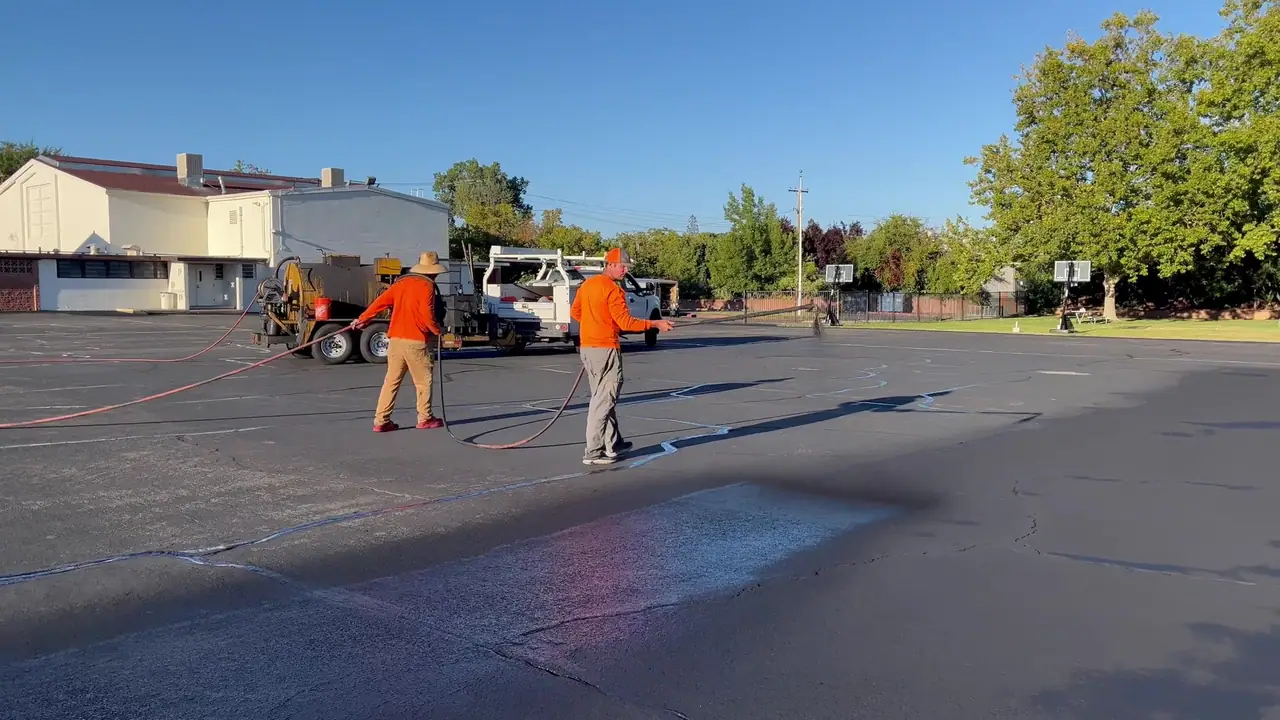
It creates a waterproof barrier that stops moisture from seeping into the base and protects the surface from the sun, which keeps the asphalt flexible. Done properly and regularly, it can double the effective life span of asphalt.
Squeegee or spray?
Squeegee for rough, worn or raveling surfaces and tight areas like covered parking, because it fills the voids and small cracks. Spray for large, smooth, newer or recently sealed lots, where a squeegee would leave too thin a film.
Should cracks be filled before sealcoating?
Yes. Seal the cracks first, then sealcoat, then restripe the lot.
When does a parking lot need restriping?
After sealcoating, after an overlay and on any new lot. If you aren't ready to sealcoat, restriping alone refreshes the lot on a smaller budget.
How soon can cars park on new striping?
Almost immediately. We use fast-dry traffic paint so you can reopen the lot quickly.
What can you stripe and stencil?
Parking stalls, ADA stalls and access aisles, fire lanes, crosswalks, stall numbers, parking destinations, directional arrows, stop signs, speed limits and custom stenciling.
Get a FREE Quote
Fill out this form to receive a FREE QUOTE on your concrete or asphalt project from Sidewalk Safety, Inc.
- Free estimates
- Licensed & bonded, CSLB #890021
- CASp partner for ADA work
Mon–Fri, 8:30am – 5pm